Smart Ceiling Fans vs Remote Fans: Technology and Key Differences
- November 26, 2026
- By Rotex Industries
- What Is the Difference Between Smart and Remote Control Ceiling Fans?
- How Does Smart Fan Technology Compare with Remote Control Technology?
- Smart Ceiling Fans vs Remote Fans: Key Feature Comparison
- Can Smart and Remote Control Ceiling Fans Work Without the Internet?
- Does Smart Technology Make Ceiling Fans More Energy-Efficient?
- Which Fan Is Better for Different Buying Requirements?
- Why Choose Rotex Industries for Smart Ceiling Fans?
- Conclusion
In the world of ceiling fans, things have come a long way from the days of simple wall regulators and speed controls. Now the market offers two popular types of control like remote control ceiling fans and smart ceiling fans with different levels of convenience, connectivity and features.
Knowing these variations assists property owners, dealers and business purchasers pick the right item. What are the distinctions in between WIFI connections? Wi-Fi links allow users to access a hand-held remote to control a light or appliance and can be used without opening an electrical box.
What Is the Difference Between Smart and Remote Control Ceiling Fans?
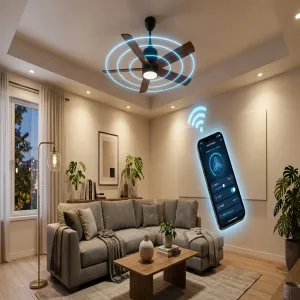
Many people got into a self-fight mode, which one is best: smart ceiling fans vs remote control ceiling fans. Here with so many new tech capabilities available for ceiling fans, that's where the 'smart' comes in. Many new smart ceiling fans can connect to a smartphone app, voice control or other smart home technology.
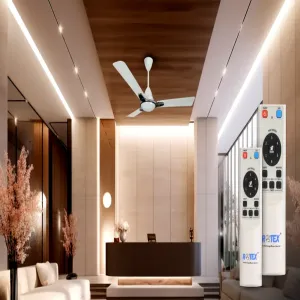
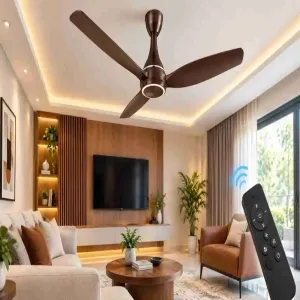
Most remote control ceiling fans come with a dedicated handheld remote to operate various functions like switching, speed and timer control. The smart fan technology can be controlled and connected to a network and has the potential for more advanced automation features and remote control fans. They use remotes for control. However, some smart fans also use handheld remotes.
How Does Smart Fan Technology Compare with Remote Control Technology?
Smart ceiling fan technology utilizes a different communication protocol than traditional remote control technology to send commands for operation. Smart fans might use Wi-Fi or bluetooth connectivity, dictated by their design. Fans with Wi-Fi connectivity are able to connect to a Wi-Fi-enabled network, providing control over the device via a smartphone app and through supported smart home platforms.
A remote-control fan operates via commands sent by a hand-held device to a receiver installed inside the fan or its control circuit. The receiver responds to the command. The primary difference is that intelligent systems allow for connected communication just like Wi-Fi ceiling fans, while traditional remote systems often transmit directly between remote and fan receiver.
Wi-Fi, Bluetooth and Mobile App Connectivity
A Wi-Fi ceiling fan can be controlled via a compatible wireless network by using an application on your mobile device. The availability of certain controls (such as speed, power, timer and voice assistant support) varies by product.
Bluetooth-enabled models will connect directly to a compatible device nearby. Most models do not need a Wi-Fi router to operate although the range and available features vary by product. You can also buy an app controlled ceiling fans, and a voice controlled ceiling fans.
Check the supported applications like compatibility to service the smart fan, compatibility to smart fan system, compatibility to voice assistant, compatibility to voice control and compatibility to network frequency before buying. Not all smart fans support different platforms of connection.
Infrared & RF Remote Control Systems
Infrared (IR) or radio-frequency (RF) are the methods of communication used in remote control ceiling fan technology.
- IR (Infrared): Light signals are sent to the receiver by the remote. Usually needs an appropriate line of sight of the remote to the fan receiver.
- Radio Frequency (RF): The remote transmits using radio signals and, in most cases, allows the unit to be operated without being directly in visual line of sight.
RF remote control ceiling fans may have an advantage over IR controllers if there is furniture, partitions or any other objects that block the line of sight between the remote and receiver.
Actual operating range varies depending on the remote, receiver design and the environment. Check the specified communication technology and available replacement remote options before purchasing.
Smart Ceiling Fans vs Remote Fans: Key Feature Comparison
Below is a brief comparison to help you see the key differences between smart ceiling fans vs remote fans and smart ceiling fan features.
| Feature | Smart Ceiling Fans | Remote Control Ceiling Fans |
|---|---|---|
| Connectivity | Wi-Fi or Bluetooth, depending on model | IR or RF |
| Control options | App, voice and sometimes remote | Handheld remote |
| Automation | Supported on compatible models | Usually limited |
| Scheduling | App-based scheduling on supported models | Timer functions on selected models |
| Voice integration | Available on compatible models | Generally unavailable |
| Installation | May require network configuration | Requires receiver and remote pairing |
| Convenience | Connected control and automation | Simple, direct operation |
Whichever option you choose, these provide easy alternatives to manual control. Whether you choose one or the other will depend on what you want it to do, installation needs and the existing set up that the product will need to work with.
Can Smart and Remote Control Ceiling Fans Work Without the Internet?
Most smart fans can be used without WiFi. However, the functions you can access depend on the products. Simple operations, e.g. fan on/off and speed adjustment, may still be accessed via a compatible local remote or local control.
But some connected features may be less available or turn off without an internet connection. These include remote control when you're away from home, cloud voice services, access to apps over the internet and some automation services. Fans that feature bluetooth capabilities will still be able to communicate with smartphones in close proximity even if they are unable to connect to the internet, as long as the app allows local bluetooth use.
Thus, even if a smart ceiling fan without Wi-Fi, it will still be usable at its most simple level, although consumers should verify which features operate without an internet connection before they decide to buy.
Does Smart Technology Make Ceiling Fans More Energy-Efficient?
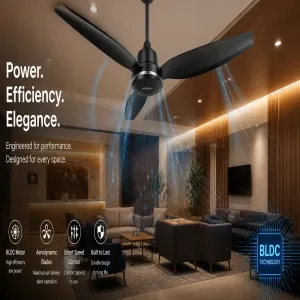
Having smart connectivity doesn't necessarily equate to higher energy savings for ceiling fans. The real end-use energy consumption will be dictated by motor technology, wattage, speed, and hours used. For instance, models with brushless direct current (BLDC) smart ceiling fans motor technology can be more efficient and consume less power than most standard ceiling fans that employ generic induction motor design. Smart functions, including scheduling and remote operation can benefit you in managing the running time and prevent the wastage.
Nevertheless, buyers should use rated power consumption, airflow performance and applicable efficiency criteria when making price comparisons instead of selecting a model based solely on its smart connectivity. Smart fans designed to be energy efficient optimally balance appropriate motor design and useful control features.
Which Fan Is Better for Different Buying Requirements?
While a remote-controlled fan is more of an indoor and office fan, a smart fan is suitable for industrial and commercial use. If the shopper wants to control their smart fan via smart device, or voice/cloud controls and home automation, then the smart is the right choice. If they just want to turn a switch on or off, a remote controlled fan is best.
- Product range, demand from your customers, technical data, availability of a spare remote control unit and warranty support all need to be taken into account.
- Having both smart and conventional remote controlled options is worth considering.
- Office, hotel, institution and other commercial premises should consider operating needs, control compatibility, ease of installation and ease of maintenance support.
- Automated or centralised operation may be an option, if supported by the product.
When buying in bulk, shoppers also want to look at the credentials of the manufacturer, production capacity, product consistency, warranty provisions and after sales service. A good smart ceiling fan buying guide should be more about the proven specifications and suitability for the product than just the ability to connect.
Why Choose Rotex Industries for Smart Ceiling Fans?
Rotex industries specializes in ceiling fan manufacturing and supply of various products suitable for various industry needs. Prospective buyers looking for smart ceiling fan manufacturers in India should check product specifications, manufacturing capacity and available customization options before shortlisting a particular manufacturer.
Rotex may be included for ceiling fan queries, sourcing of dealers and OEM/private label opportunities, if the relevant product feature abilities are in stock. If you are searching for high quality and good features from smart ceiling fan suppliers in India or smart ceiling fan dealers in India then you can talk to the company directly.
Learn more about Rotex and get in touch with our team to ask about our products, specifications and bulk order needs.
Conclusion
Smart and remote control ceiling fans both bring easy control at your fingertips. Smart ceiling fans and remote control ceiling fan models have different ways to operate. Smart fans can deliver connected control, apps and potential automation while remote control fans are about direct control.
The optimal alternative hinges on connectivity needs, ease of use, motor efficiency, compatibility, and confirmed product specifications. Interested in a product, selling in bulk or a supplier's enquiry, talk to RotexFans for the right ceiling fan solution.
Smart ceiling fans allow connected control via Wi-Fi, bluetooth or compatible smart home integrations. Remote control ceiling fans typically only come with a dedicated IR or RF remote.
Yes, some models. You may still be able to operate the robot remotely with a handheld remote or locally using bluetooth connectivity. The cloud-based apps, external remote access, and some of the voice assistant capabilities may depend on having access to the internet.
Certain remote control fans are available as upgrade options that feature aftermarket installation kits. These kits include a compatible smart controller or retrofit module. Compatibility is based on the fan motor and receiver, as well as the wiring and controller specifications and electrical safety, warrantee and manufacturer approval. It's recommended you have a professional install it.
Not always. The energy savings of a ceiling fan are driven by the quality of the motor technology, its rated wattage, airflow and the environment in which it's operating. There are many 'conventional' fan motors that are more efficient than BLDC smart ceiling fans.
Buyers should evaluate before selecting smart ceiling fan manufacturers in India:
- Warranty terms and after-sales support.
- Wi-Fi, bluetooth and voice assistant compatibility.
- Manufacturer credentials and production capabilities.
- Verified product specifications and motor technology.
- Product quality documentation and applicable certifications.
- Package quantity, order lead times, OEM/private-label choice.
These parameters serve to compare the attributes and qualities of a seller, making them able to find dependable smart ceiling fan manufacturers and suppliers in India for their commercial as well as residential needs.
Buyers can contact Rotex industries for further details of their smart ceiling fan range for confirmation of models, manufacturing specifications, technical specifications and product features.